Forex for beginners: a step-by-step start from currency pairs to your first trade
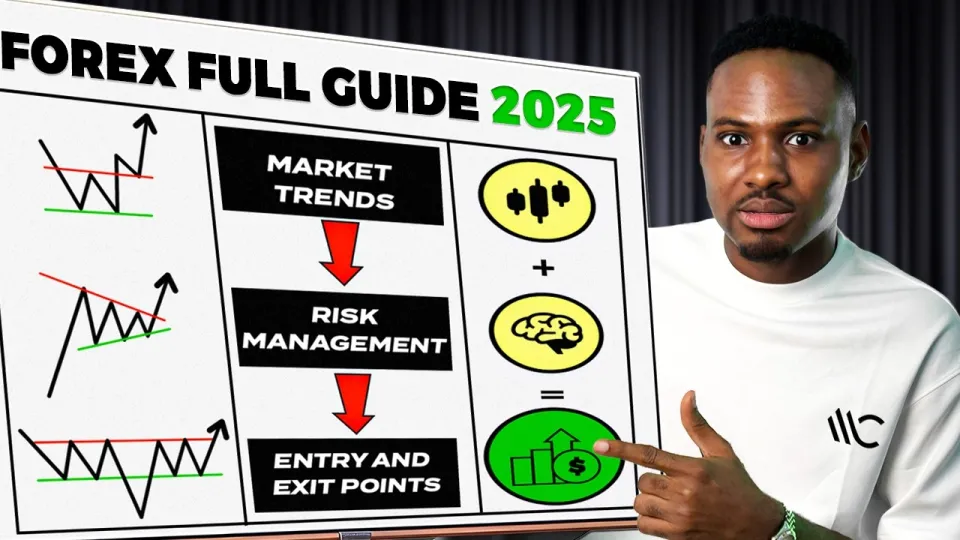
Video: How To Start Forex Trading For Beginners’ 2025 (Full Course)
Need articles like this for your video? They help promote it on YouTube and Google — order them in the Telegram bot @sat_sit_bot. The bot writes and publishes the articles itself (with your YouTube video embedded) on popular topical websites (no ads). Free trial — 50 articles.
· based on the channel Jeffrey Benson Forex
Forex for beginners is the process of learning how currencies are quoted in pairs, how the market's sessions and leverage work, and how to place a first small, risk-defined trade on a demo account before risking real money. The practical path is short: understand the instrument, set up a platform, write down one simple strategy, size the position correctly and only then fund a live account. A structured starting point — including the instructor's own course and student plans — is available at the Fire Pips FX plans page.
What forex actually is and how a currency pair is priced
Forex is a decentralised over-the-counter market where one currency is priced against another, and every quote is a ratio between two economies. When you see EUR/USD at 1.0850, the euro is the base currency and the dollar is the quote currency: one euro costs 1.0850 dollars, and a long position profits if that number rises. There is no central exchange, no opening bell and no single order book — banks, funds, brokers and retail traders deal through a network of liquidity providers, which is why spreads can widen or narrow within seconds.
Three terms cover most of the vocabulary a beginner needs:
- Pip — the standard smallest move in a pair, usually the fourth decimal (0.0001), or the second decimal in yen pairs.
- Spread — the gap between bid and ask, which is the broker's built-in cost of every trade; a tight spread on EUR/USD and a wide one on exotic pairs changes the maths of a strategy completely.
- Lot — the position unit; one standard lot is 100,000 units of the base currency, and most beginners should trade micro lots (0.01) so a normal stop-loss costs a few dollars rather than a few hundred.
Major pairs such as EUR/USD, GBP/USD, USD/JPY and AUD/USD carry the tightest spreads and the deepest liquidity, which is why almost every beginner curriculum starts there rather than with exotics like USD/TRY or USD/ZAR.
How the forex market works across sessions and timeframes
Forex trades around the clock from Sunday evening to Friday evening, and the behaviour of price changes with the session that is open. Sydney and Tokyo come first, then London, then New York; the London–New York overlap is the busiest window of the day, when volume and volatility peak and spreads are usually at their tightest. The quiet Asian session often produces ranges, while the London open frequently produces the directional moves that trend traders wait for.
Timeframes matter as much as sessions. A beginner should pick one working timeframe — the 1-hour or 4-hour chart is a reasonable default — and use a higher timeframe such as the daily only for context: is price trending, ranging or sitting at a major level? Trading the 1-minute chart in the first week is the fastest route to noise, over-trading and a blown demo balance. A simple top-down routine works: mark the daily levels, drop to the working timeframe, and wait for price to reach a level rather than chasing it.
The tools a beginner needs before the first trade
A beginner needs four tools, and none of them is a paid signal group: a demo account, a charting platform, an economic calendar and a journal. MetaTrader 4 and MetaTrader 5 are the standard retail platforms and are free with most brokers; TradingView is a common alternative for chart work. The economic calendar matters because interest-rate decisions, CPI prints and non-farm payrolls can move a pair 100 pips in minutes — knowing when they land is part of risk management, not optional homework.
When choosing a broker, check four things rather than the bonus offer: regulation and the jurisdiction behind the licence, the spread on EUR/USD during your trading session, the minimum deposit and lot size, and how fast withdrawals are processed. Fund a demo account first and trade it for at least a month or 50 logged trades before depositing real money; the goal of the demo is not profit but a repeatable process you can describe in writing.
Building a basic strategy foundation
A workable beginner strategy is a set of rules for entry, exit and risk that you can follow when you are tired, bored or emotional. Most simple frameworks are built on two ingredients: a direction filter and a trigger. The direction filter could be a moving average or a higher-timeframe trend; the trigger could be a pullback into a level, a break of a session high, or a candle pattern at support and resistance. Support and resistance levels are simply prices where buyers or sellers previously stepped in strongly enough to reverse the move.
Write the rules down before you look at a chart:
- Which pair and which session you trade.
- What must be true on the higher timeframe for you to take a trade at all.
- The exact entry trigger and where the stop-loss goes.
- Where you take profit or trail the stop.
- The maximum number of trades per day and the maximum daily loss.
A strategy that wins 45% of the time with a 1:2 risk-to-reward ratio is profitable; a strategy with a 70% win rate and no stop-loss is a countdown. Beginners usually fail not because the entry is wrong but because the exit and the position size are improvised.
Placing your first trade and sizing it correctly
Position sizing is the single most important calculation in retail forex, and it is arithmetic rather than intuition. Decide the percentage of the account you are willing to lose on one trade — 1% is the common beginner ceiling — then divide that money by the distance to your stop-loss in pips to get the lot size. On a $1,000 account risking 1%, the risk budget is $10; if the stop is 20 pips away on EUR/USD, a micro lot (about $0.10 per pip) puts the loss at roughly $2, so the correct size is nearer 0.05 lots.
Execution itself is mechanical: set the order type, attach the stop-loss and take-profit in the same ticket, and confirm the lot size before pressing buy or sell. Leverage is not a strategy — 1:500 leverage does not increase your edge, it only reduces the margin required and makes oversized positions possible. Most brokers also allow a stop-loss to be set at order entry, which removes the temptation to "watch it and decide later".
Common mistakes that empty a first account
The classic beginner mistakes are behavioural, which is why they repeat across accounts and brokers. Over-leveraging on a small deposit, trading without a stop-loss, moving a stop further away to avoid being wrong, and revenge trading after a loss account for most first-account blowups. A second cluster is analytical: switching strategies after two losing trades, trading during major news without understanding the exposure, and taking setups that are not in the written plan.
A journal fixes more of this than any indicator. Record the pair, session, reason for entry, risk in percent, screenshot and outcome for every trade; after 30–50 entries, patterns appear — the losing trades usually share a time of day, an emotional state or a rule that was skipped. Treat the first live account as tuition: small size, one strategy, one pair, and a hard rule that a 5% drawdown in a week means a return to demo.
What beginners usually ask before starting
Most of the hesitation around starting comes from a handful of recurring concerns: how much money is enough, whether trading can be learned from free material, how long the learning curve lasts, and whether signals can replace skill. The honest answers are unglamorous — start with an amount you can lose without changing your life, expect months rather than weeks, and treat any signal service as an input to your own risk rules rather than a substitute for them. The most common regret voiced by people who have traded for a while is not having learned risk management first.
Useful links
- Fire Pips FX student plans — the instructor's course and mentorship options.
- Fire Pips daily signal channel — one free trade idea per day on Telegram.
- Assex Markets registration — the broker referenced in the course.
- Jeffrey Benz premium help bot — access to the premium signal group.
The takeaway
Forex rewards process and punishes improvisation: learn the pairs, pick one session and one timeframe, write a strategy with a defined stop, size every position from the risk budget rather than from confidence, and log everything. A demo month costs nothing and reveals more about your temperament than any course chapter. The full beginner walkthrough behind this article comes from the Jeffrey Benson Forex channel, and its structured student programme is available through the Fire Pips FX plans page if you want guided progression rather than self-study. Start small, stay boring, and let the journal — not the account balance — tell you when you are ready to scale.
Key takeaways
- Forex is an over-the-counter market where currencies are quoted in pairs, such as EUR/USD; there is no single exchange or closing bell.
- The market runs 24 hours on weekdays across four sessions: Sydney, Tokyo, London and New York, with the London–New York overlap the most liquid window.
- A beginner needs a demo account, a charting platform such as MT4 or MT5, an economic calendar and a trading journal — not a pile of indicators.
- Position size, not the entry signal, decides survival: risk a fixed small percentage of the account per trade and place the stop-loss before entering.
- The fastest way to lose a first deposit is high leverage plus no stop-loss plus revenge trading after a loss.
Questions & answers
How much money do I need to start forex trading?
There is no universal minimum, but the amount should be money you can lose without affecting your life. Many beginners start with a few hundred dollars on a micro-lot account, because the point of the first live account is to practise execution and risk discipline, not to generate income. A larger balance mainly allows smaller relative risk, not better returns.
Can I learn forex trading for free?
Yes — platform demos, broker education sections and free video courses cover the mechanics of pairs, spreads, leverage and chart reading. What free material rarely provides is feedback on your own trades, which is why a written journal and a demo period of at least 50 logged trades matter more than another tutorial. Paid mentorship is optional and should be judged on risk-management content, not profit promises.
Should I copy signals instead of learning to trade?
Signals can be useful for watching how an experienced trader structures entries and stops, but following them blindly means you inherit the risk without the reasoning. If you use a signal channel, apply your own position sizing and stop-loss rules and record the outcome in your journal. Skill still has to be built, because the signal provider is not there when the market moves against you.
How long does it take to become consistently profitable?
Most traders need many months of screen time and hundreds of logged trades before results stabilise, and some never get there because risk rules are abandoned under pressure. A realistic path is a demo month, then a small live account with one strategy and one pair, reviewed weekly. Progress should be measured by rule adherence and drawdown control first, and by profit second.
Source: How To Start Forex Trading For Beginners’ 2025 (Full Course) · Markdown version